A mini purse works because it forces an edit, which is exactly what an evening bag should do. I run the phone test, then look at how the strap decides the occasion.

The Mini Purse Survived Its Own Backlash
The phone test
There is a hard line between a mini purse that fits a modern phone and a novelty object, and it is the only spec that matters. Every bag below clears it. Anything that does not is jewellery with a strap. The tiny bag arrived as a joke about status and stayed as a genuine category, which is roughly the arc of most 2010s fashion. The phone got bigger at exactly the wrong moment.
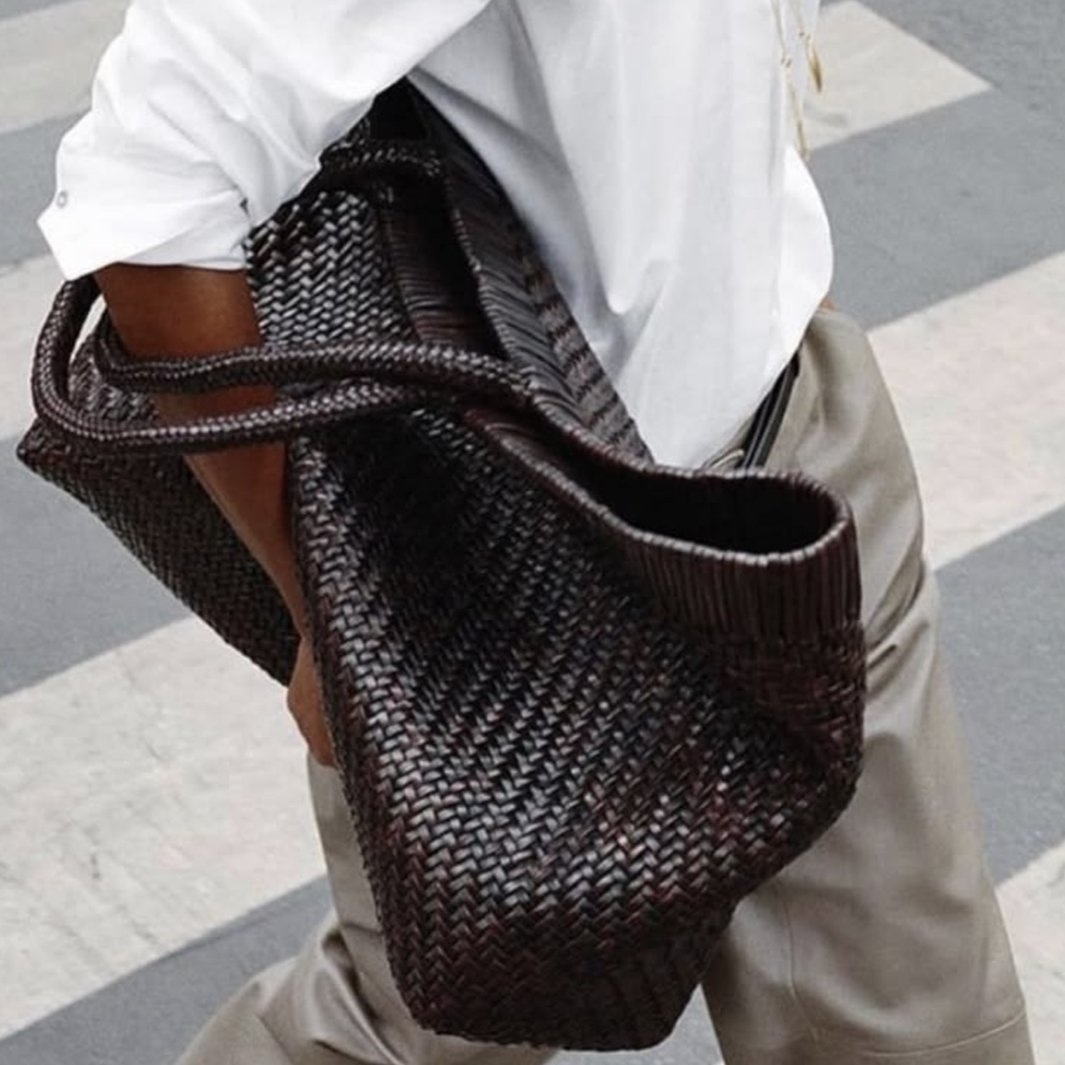
In the first row, Janessa Leone's Mini Leoné and STAUD's Brooklyn are proper leather bags scaled down, Bottega Veneta's Mini Arco copies the house's woven intrecciato in matte rubber, and Bembien's Nille Petite is braided leather made by hand in India.

Enzo Clutch Bag
A.L.C.
$350

Mini Leoné Leather Top Handle Bag
Janessa Leone
$900

Drummer Bag
A.P.C.
$795

Brooklyn Leather Shoulder Bag
STAUD
$450

Amara Texture Mini Bag
Aje
$329

Mini Arco Rubber Shopping Bag
Bottega Veneta
$990

Aike Small Bucket Bag
Ann Demeulemeester
$1,690

Nille Petite Braided Leather Shoulder Bag
Bembien
$275
Strap decides the occasion
A shoulder chain reads evening, a short top handle reads formal, and a crossbody makes a mini bag genuinely usable in daylight. Most people should buy the one with a detachable strap and get all three. Shape matters far less than that. Strap choice does more to set an occasion than colour or material does, which is unusual for an accessory. It is the difference between a going-out object and a daily one.
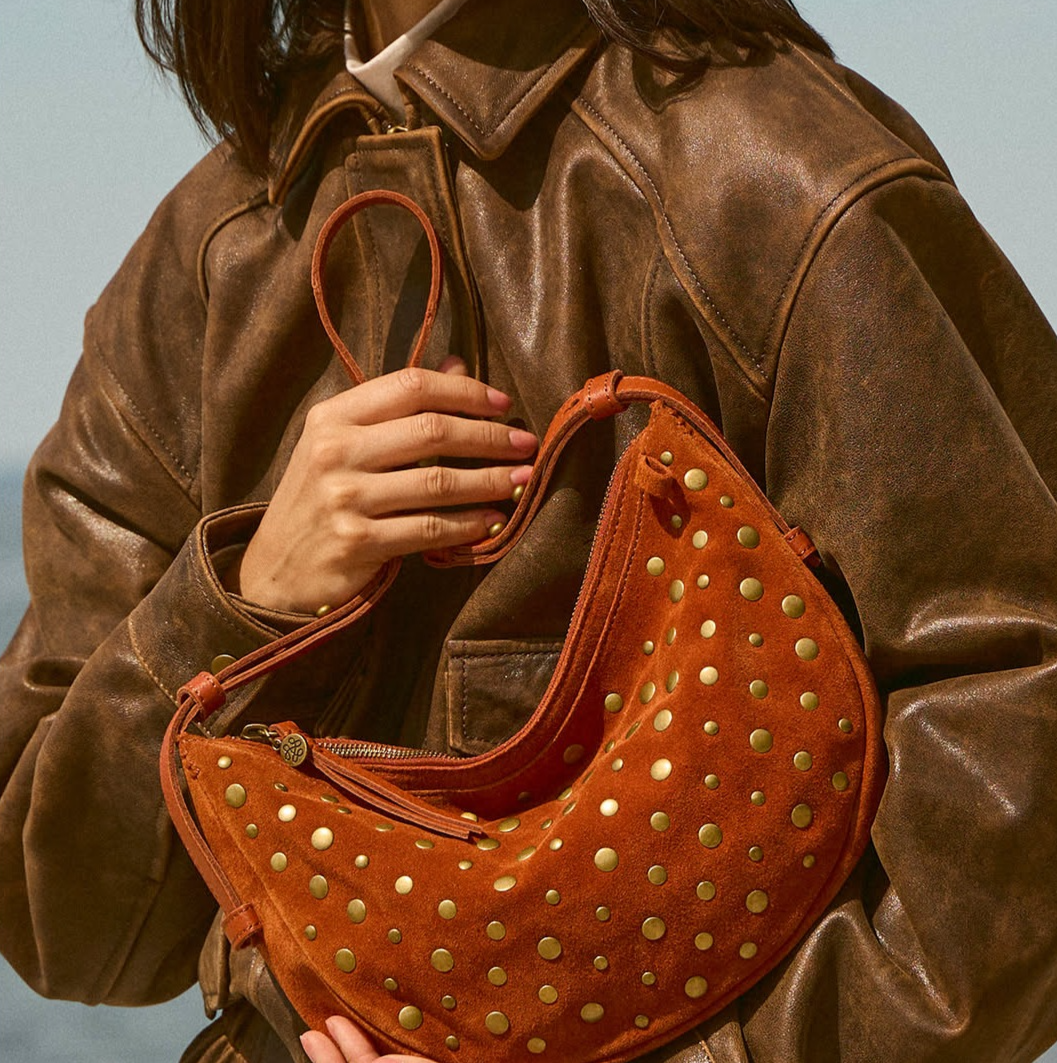
Cult Gaia shows how much a strap can change. Jasmin Larian started the label in Los Angeles in 2012, straight out of FIT, making flower crowns for friends, and her bamboo Ark bag famously sat unsold for two years before it took off. Her minis here cover the whole range: the Mercier hangs from a short beaded strap, the Fiore converts into a crossbody, and the Tazia and the studded Gili sit close under the arm.

Mini Longa Pony Hair Top-Handle Bag
By Far
$570

Mercier Mini Shoulder Bag
Cult Gaia
$898

TAMPA MINI BAG
Isabel Marant
$850

Fiore Convertible Crossbody Bag
Cult Gaia
$498

Roma Croc-Embossed Leather Shoulder Bag
Jonathan Simkhai
$645

Tazia Shoulder Bag
Cult Gaia
$418

SOLENE MINI BAG - NATURAL SHEARLING
Cult Gaia
$498

Gili Shoulder Bag
Cult Gaia
$598
Small bags used to mean evening
Until quite recently a small bag was an evening object, descended from the reticule and the minaudiere and expected to hold almost nothing. That changed when Fendi's Baguette turned a small bag into a daytime status piece in the late 1990s, and the category has never gone back. The micro wave of the late 2010s pushed the idea to the point of parody, and what has settled since is a bag that is small but functional. This is a genuinely new category rather than a revival, which is unusual in accessories. It is also why sizing conventions here are still so inconsistent.
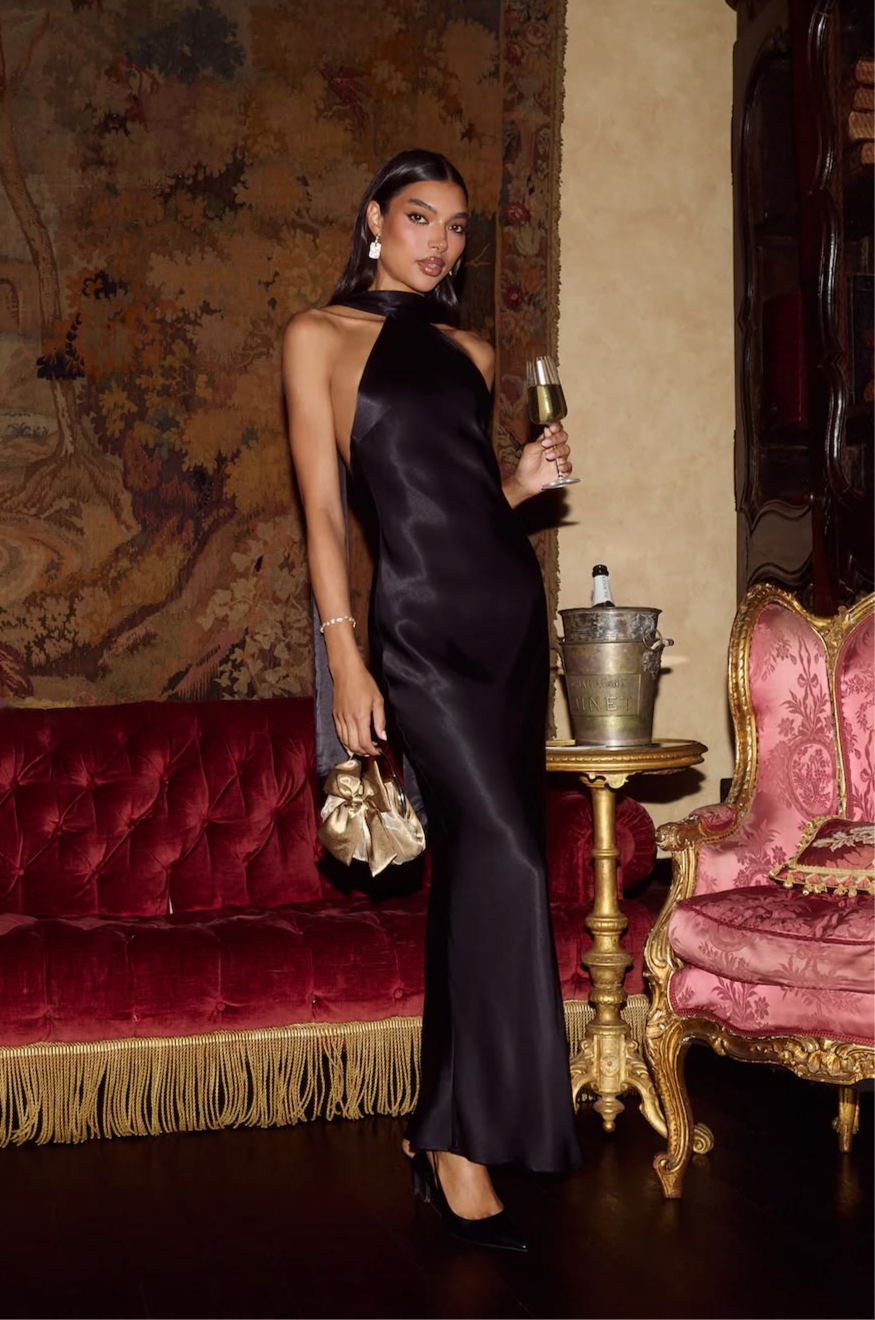
The evening row keeps that minaudiere spirit. Simkhai's Marion is a gold metal shell, Cult Gaia's Nala is silver leather pleated into a fan, the Lia is satin on a removable gold chain, and Mélisse's Minuit is a taffeta take on the Japanese knot bag.


Structure holds its value
A small structured bag keeps its shape empty, which matters far more at this size because there is nothing inside to fill it out. Soft unlined leather at small scale collapses into a shapeless pouch the first time it is set down. Look for a reinforced base and a lined interior, since both are frequently dropped from smaller styles on the assumption nobody checks. A rigid frame or a firm gusset is what separates a bag that photographs well from one that only photographs well in a studio. At this scale construction is the entire product.
Toteme's Mini T-Lock clutch is the clean example, Italian cow leather held shut by the turn-lock on the front.

NOVA BAG - LUWAK
Cult Gaia
$498

Atlas Leather Shoulder Bag
Jonathan Simkhai
$495

Mini Loaf Suede Bag
Joseph
$645

Hudson Crystal-Embellished Wicker Bag
Emm Kuo
$530

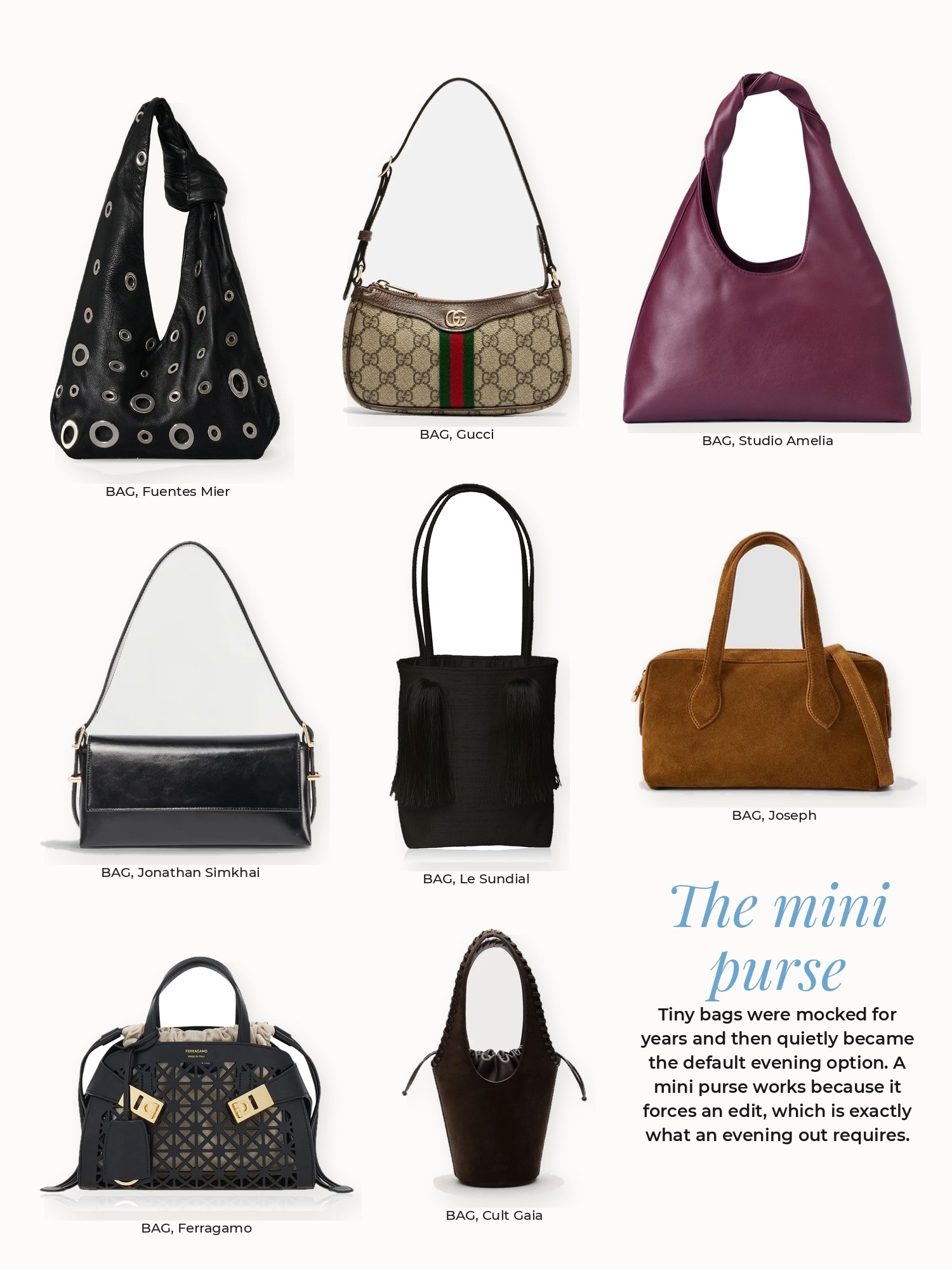
Ophidia Mini GG shoulder bag
Gucci
$850

Siena Mini Hobo Leather Bag
Studio Amelia
$490

Mini Diana Bag
Fuentes Mier
$795

Jaala Mini Clutch
Cult Gaia
$698

Salon Mini Silk-Blend Tote
Le Sundial
$850

Hug Leather Mini Bag
Ferragamo
$2,500

Gold Suede Café Mini Bag
Verafied
$228

Asa Shoulder Bag
Cult Gaia
$558

Pinet Mini Raffia Tote Bag
Emm Kuo
$315

Lune Mini Sequin Bag
Merlette
$420

Chérie Re-Nylon Mini Bag
Prada
$1,720

Icon Mini Crossbody Bag in Sand
Antler USA
$100

Janie Shell Bag
Andie's Swim
$276

Exclusive La Isla Wood-Beaded Mini Bag
Cordera
$370

Hilma Mini Black Leather Bag
ALOHAS
$245

Full Circle Convertible Clutch
Aimee Kestenberg
$248

Cannon Ball Mini Palm Tote Bag
Johanna Ortiz
$840

The Leather Mini Bag
Marc Jacobs
$138.6

Le City Bag Mini
Balenciaga
$2,100

Mini T-Lock Leather Clutch
Toteme
$760

Mini Bou Bag
GANNI
$367.5

Lila Embellished Mini Bag
STAUD
$395

Maude Mini Leather Carryall Bag
STAUD
$395

Kensington Mini Vinyl Top Handle Bag
Kurt Geiger London
$138.6

Ramatelle Beaded Bag
Emm Kuo
$520

Niki Mini Handbag in Vintage Leather
Saint Laurent
$2,150

Mini Textured Leather Bucket Bag
Ferragamo
$1,250

Chéri Leather Mini Clutch
Bembien
$295

Scene Mini Leather Convertible Crossbody
Marc Jacobs
$198

Le Grand Bazaar Mini Suede Top Handle Bag
Sandro
$450

Celebrating Heritage Mini Bucket Bag
Johanna Ortiz
$395

Skye Mini Satin Top Handle Bag
Reformation
$268

Plaza Mini Black Leather Shoulder Bag
COACH
$95

Pampelonne Mini Raffia Hobo Bag
Emm Kuo
$275

Metro Small Quilted Smile Bag
MZ WALLACE
$145

Love One Mini Black Quilted Leather Crossbody Bag
PINKO
$296.25

Auden Small Raffia Bag
Janessa Leone
$700

M Mini Leather Bag
Maje
$228

Vega Mini Suede Shoulder Bag
ALLSAINTS
$134.55

Heritage In Motion Mini Braided Tote Bag
Johanna Ortiz
$950

Jack Mini Waxy Suede Crossbody Bag
Zadig & Voltaire
$548

Ida Trio Mini Leather Crossbody Bag
Wandler
$725

Fleming Mini Quilted Suede Crossbody Bag
Tory Burch
$262.5

Leather Mini Leather Bucket Bag
MAISON de SABRÉ
$528
Small scale, bolder texture
Choose the small bag in a colour or texture you would not commit to at full size, because the risk is proportional. Beaded, shell, patent and metallic all work at this scale. Emm Kuo's wicker Hudson studded with crystals and her beaded Ramatelle, Cordera's wood-beaded La Isla and Johanna Ortiz's palm minis made in Colombia are where I would start. That is the actual argument for the category. The risk on a small bag is proportional to its size, so this is where to take the colour you would never commit to at full scale. Small is permission. If you want to keep browsing, I also put together How to Style the Heart Purse and Coach Purse.